

So many years ago now, I met Sarah Pedinotti playing a live music gig downtown for the opening of Sculpture in the Streets in Albany. This was back when Tom Birdsy was Principle at Einhorn Yafee Prescott (EYP), an anchor / international architectural firm in downtown. Fast forward many years and Sarah (LIP TALK) is now flexing as a seasoned international artist with her project ‘Youngworld: The Mantis Shrimp Matrix’. This multi-media installation recently debuted in the United States after a successful run in Bangkok, where it was originally conceived, and Tokyo. The work combines site-responsive sound design, electronic visual elements and a sculptural environment built from discarded and ocean-bound materials, exploring human relationship with the natural environment through the lens of an anthropomorphized Mantis Shrimp.

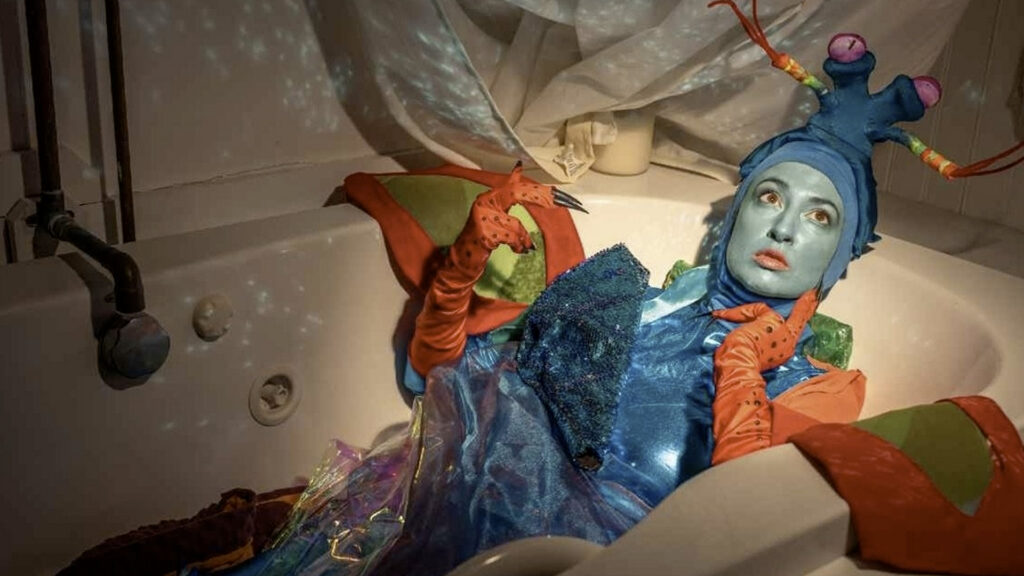
Please state your name, what it is that you do and a little about your educational background and how you came to your practice.
My name is Sarah Pedinotti. I make music under the name LIP TALK, and I’m an interdisciplinary artist working across sound, installation, performance, film, and sensory experience. I started as a musician, composer, and producer, and over time I’ve learned to follow an idea into whatever medium it seems to require. I think I’ve always learned by being in the middle of things. I grew up in my family’s restaurant and started bussing tables when I was twelve. I was also singing and sitting in with the musicians at that time. One of my early mentors was Lee Shaw, the extraordinary jazz pianist and composer who was based here in the Capital Region. That kind of direct mentorship shaped me enormously.
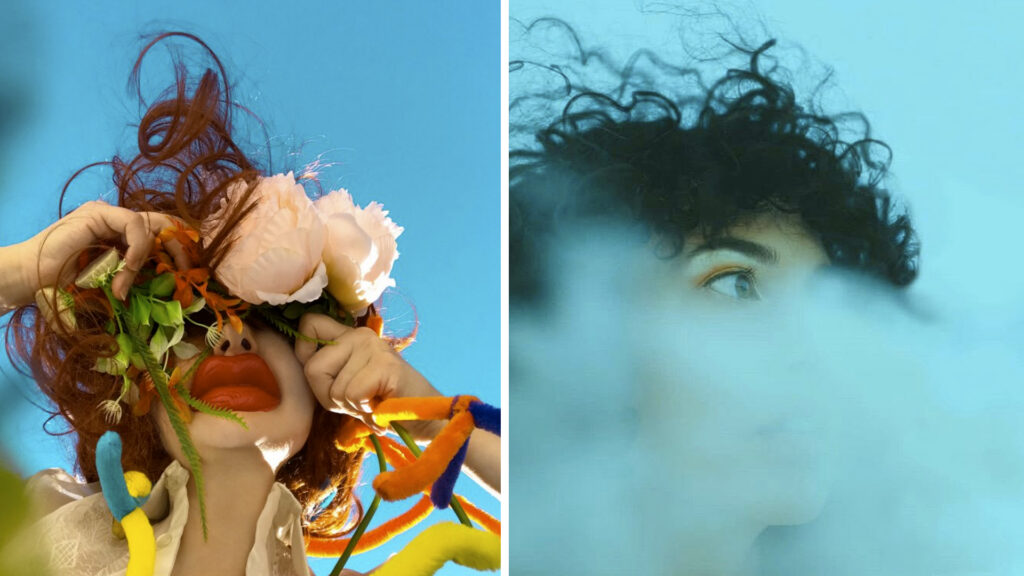
Laughing and Eating Cake – Image : Walter Price
Days – Image : Provided
From there, my education became a mixture of mentorship, formal study, and just doing the work. I received a scholarship to study contemporary writing and production at Berklee, and later studied philosophy and anthropology through Harvard Extension. But I’ve probably learned just as much through making records, touring, collaborating, and putting myself in situations where I don’t already know how to do the thing I’m trying to do.
That’s still how I work. If an idea leads me into circuitry, modular synthesis, filmmaking, movement, sculpture, or another field entirely, I follow it. I’m interested in what happens when knowledge from different worlds gets put into conversation.
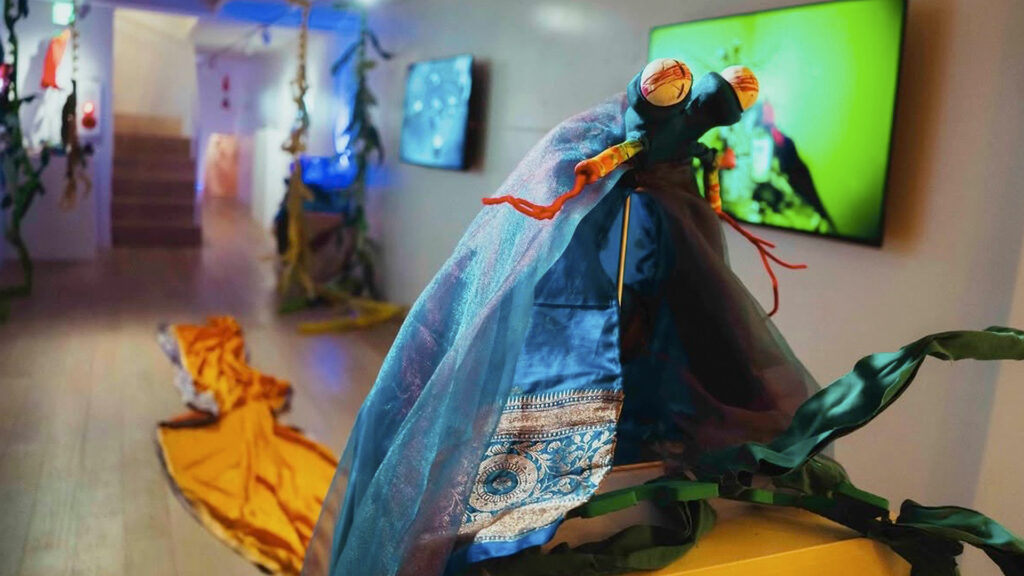
Can you explain a bit about the genesis of the Mantis Shrimp Matrix project?
Mantis Shrimp Matrix began as an attempt to imagine a reality I cannot access. I became fascinated by the mantis shrimp because its visual system is extraordinarily complex and radically different from ours. Its lineage stretches back roughly 400 million years, and it has evolved sensory capacities that feel almost like superpowers from a human perspective. I started wondering: could I translate even one aspect of that sensory world into something my body could perceive?
While I was living in Bangkok, I worked with composer Pradit Saengkrai and technologist Thida Choowong at Rangsit University to build a system using infrared sensors, Arduino hardware, and modular synthesis. The sensor could detect information in the environment that our eyes weren’t perceiving and translate it into sound. It was rudimentary, but it was thrilling. At the same time, I had built this ridiculous mantis shrimp helmet that visitors were supposed to wear, with sensors inside it. The night before the exhibition opened, I couldn’t get it to work. I stayed up all night and made a guided meditation instead, asking people to grow mantis shrimp eyes in their imagination. That failure completely changed the project. I had been trying to build a machine that could extend human perception, and suddenly I realized that the instrument I was most interested in was the imagination.
I started by asking about the mantis shrimp’s evolutionary superpowers and the project began turning that question around: what are ours? Imagination is certainly one of the extraordinary capacities we have. We can imagine an experience we’ve never had. We can imagine another person’s perspective, another creature’s world, something that doesn’t exist yet.
But there’s a shadow side to that capacity too. Human beings create systems, categories and shared realities so powerful that we can begin to mistake them for reality itself. We inherit ideas about what is normal, what is valuable, what belongs where, which lives we notice, and what counts as waste. So the project started turning the lens back on us. If the world I perceive through this particular human body is only one version of reality, then maybe the human world I’ve inherited isn’t as fixed as it sometimes feels either.
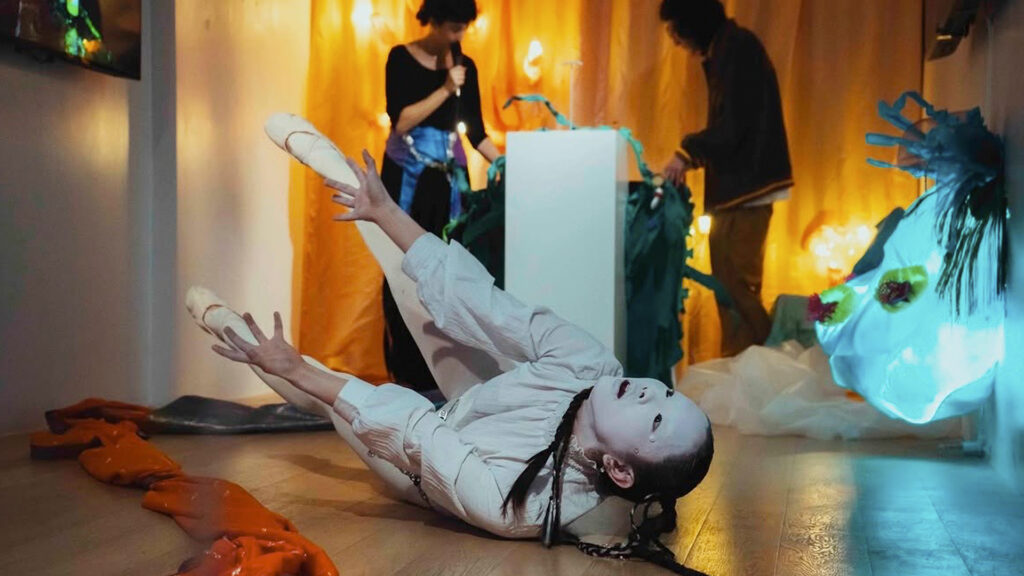
What are you hoping to accomplish with this traveling exhibition?
I actually think of Mantis Shrimp Matrix less as one exhibition that moves and more as a framework for making many different exhibitions around the same evolving inquiry. I’ve spent a lot of my life touring in bands, and touring usually works something like: “Hey, I made this thing. Now I’m going to bring it to your city.” With this project, I’m interested in almost the opposite approach. I arrive with an inquiry: What happens when I bring this question here? What materials are here? What do the insects and birds sound like here? What wisdom exists here? Who is here? What do they do here? What is indigenous to here? What happens when a mantis shrimp encounters this place?
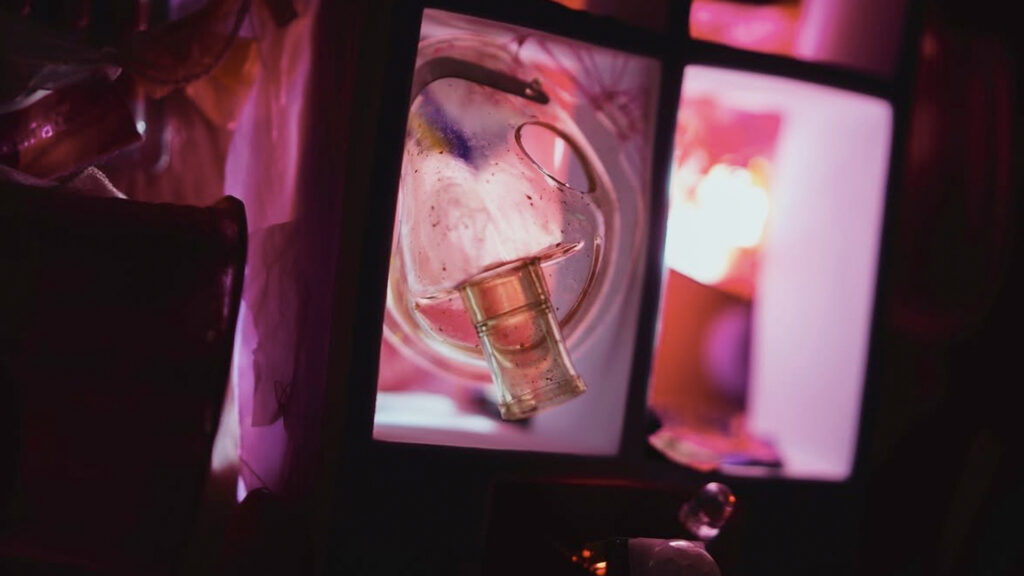
So every iteration is different. I build with materials discarded in that region and make field recordings of the life around me. The performance work responds to the place too: I inhabit this mantis shrimp character and take it out into the world, interacting with people and documenting what happens. I invite local musicians, performers, scientists, students, environmental organizations, and other artists into the project. Performances, workshops, conversations and experiments grow around the installation. The community and the environment change the work every time. That’s become increasingly important to me because imagination doesn’t have to remain private. You imagine something and put it into the world, somebody else encounters it and brings something you couldn’t have brought yourself…the original idea changes.
There is ecological grief in the work, and I don’t want to turn away from the darker side of our impact. I’m literally asking people to walk into a room and look at a wondrous display of our trash. But there’s also humor, play, music, sensuality, absurdity, and a lot of joy. I want to create a space where those things can coexist, because maybe that’s how we stay present with something painful without becoming numb to it. I’m interested in creating spaces where curiosity can become collective and where we can look honestly at the mess we’re in, together. I’m realizing that I approach the whole project the way I’ve always approached improvising music: you listen closely, you respond to what’s happening in real time around you, and in that moment you’re present enough to let it change you.
Now that you are back in the States, how do you see this as having continued importance?
Coming back to the United States has made the project feel more connected. One of the things that affected me deeply in Southeast Asia was realizing that waste is global everywhere though we experience it as local. We throw something “away,” and that word creates this strange illusion that it has left our world. But there is no away. Our waste moves through neighborhoods, countries, economies, bodies, rivers and oceans. The consequences may disappear from our view, but they don’t disappear. That’s part of why it felt important to bring this inquiry home. In Saratoga, I built with materials reclaimed from the Capital Region waste stream. As the project continues to move, I want each installation to carry the material fingerprint of the place where it exists. What are we consuming here? What are we throwing away? What does our trash reveal about the systems we’re living inside? That also creates a connection between places that might otherwise seem very far apart. A piece of packaging in Bangkok can look almost identical to something I find in New York because we’re participating in the same systems. The scale of those systems can feel completely overwhelming. It’s easy to wonder what difference it makes whether I use a plastic straw when the problems are so much bigger than one person’s choice. And I think both things are true. Changing a straw isn’t going to fix a global system, but the systems we live inside are also being reinforced through millions of ordinary decisions, relationships and assumptions every day.
That’s where imagination comes back into the project for me. What role does imagination play in our evolution? I’m interested in smaller ripples that remind me to be in community. We inherited these systems, we participate in them, and we’re also continually making them. That means we’re not outside the mess, but we’re not powerless inside it either. We are incredibly young as a species, capable of extraordinary destruction, but also perhaps still learning how to be this animal. I might be building a coral reef sculpture with a plastic straw, but what I’m really asking is what kind of species we are practicing becoming.

What’s next for you?
I’m about to enter a residency at Yaddo, which feels like an important moment because I’ll have concentrated time to ask what the next form of this work wants to be. Mantis Shrimp Matrix has grown enormously since that first installation in Bangkok, and I’m interested in letting some of these ideas around perception, embodiment, sound, material memory, and ecological interdependence move into new forms.
Before that, I’m bringing a small piece of Youngworld to the Empire Arts Summit at The Egg in Albany. I’ll be making new edits of some of the films and bringing in sound from the Saratoga installation to transform a little corner of The Egg. I’m excited to let the work have another life there and to reconnect with the larger New York arts community.
I’m also teaching a workshop at Caffè Lena in November called Forget Everything You Know and Remember All the Things You Are. It begins with a question I’ve been thinking about a lot: Who were you before the world told you who to be? It’s another way of exploring imagination as a tool for seeing outside the systems we’ve inherited. And then the work is starting to move beyond the exhibition itself.
My partner, MUEBON, a Thai street artist, and I are in the early stages of forming a nonprofit at the intersection of art, community, and habitat restoration. We’re developing projects in Okinawa and on Ko Sichang in Thailand that bring artists, scientists, and local communities together around marine restoration. One of those projects has a story that feels almost impossible to me. Earlier this year we met Inson Wongsam, a celebrated Thai artist now in his nineties. Nearly sixty years ago, while living in New York, he witnessed industrial pollution being dumped into the ocean off Long Island and designed sculptural structures meant to be submerged underwater to become habitat for marine life, but wasn’t able to secure the funding to realize them. We’re now working with a community-run marine conservation center on Ko Sichang to explore bringing those designs into the ocean using a material that coral can grow on.
There’s something very moving to me about an idea traveling across generations and oceans like that. In the late 1960s, a Thai artist in New York witnesses industrial waste entering the ocean and imagines art becoming habitat. Nearly sixty years later, a New York artist in Thailand is making work in response to ocean waste, and our paths cross. Now that idea is entering into a new conversation with a community working to restore marine life on Ko Sichang, and we’re seeing what it might become there.
Finally, I’m continuing to make music too. Sound and improvisation are really at the foundation of how I work. Guitarist Xander Naylor and I are beginning to organize a series of improvised performances with collaborators in Mumbai, Hong Kong, Tokyo, and Thailand next year, continuing this practice of listening and responding to a place in real time. I’m also developing the guided meditations I’ve created for Mantis Shrimp Matrix into standalone sound works, so they can exist both within the installation and be experienced independently.
WEB: liptalk.space